

City profile
Houston, Texas, is the fourth-largest city in the United States and a major global center for the energy and healthcare industries. It is located in southeast Texas near the Gulf of Mexico, and it hosts the Port of Houston, one of the world’s busiest ports and home to massive petrochemical processing facilities. These infrastructural strengths generate substantial economic activity. However, when combined with Houston’s flat geography and subtropical climate, they also pose air quality challenges, including elevated levels of ground-level O3 (ozone) and NO2.
Asthma is a major health concern in Houston, with rates of pediatric asthma notably higher than in many other U.S. cities. Both ozone and NO2 are potent triggers of asthma exacerbations. By analyzing city air quality and 911 dispatch data, the Houston Health Department noticed that, on days when ozone and NO2 levels were high, ambulances and emergency medical technicians (EMTs) spent a considerable amount of time responding to pediatric asthma attacks, which are largely preventable. This left fewer ambulances and EMTs to respond to other health emergencies. In addition, Health Department officials noticed that the burden of asthma exacerbations fell disproportionately on disadvantaged neighborhoods, creating health inequities that the Health Department sought to mitigate.
Houston is a “Home Rule” city and, in general, Houston’s mayor and City Council have broad authority to promulgate regulations within Houston city limits. However, its ability to pass and enforce air quality policies is constrained by state laws and the Texas Commission on Environmental Quality (TCEQ). As a result, city-run air quality and public health interventions generally focus on voluntary programs, supplemental air quality monitoring, and information-based solutions rather than mandatory local emission standards.
Local clean air solution
Program overview
To address the challenge of excessive and inequitable pediatric asthma exacerbations—and to refocus critical EMT services for other health emergencies—Houston Health Department officials proposed a voluntary, information-based program to raise awareness of poor air quality days. City officials hypothesized that notifying school nurses and families when forecasting tools predicted poor air quality would enable them to prepare for the increased risk of asthma attacks more effectively. For example, school nurses could monitor children with asthma more closely and ensure they had access to appropriate medication and other means of asthma self-management. In turn, Health Department officials designed the Asthma Air Aware Alert System.
Key features
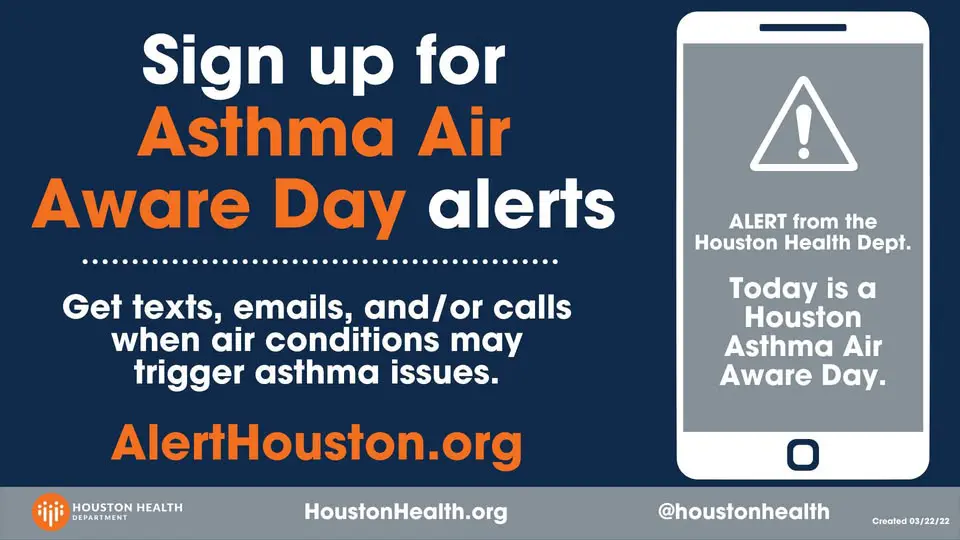
The Asthma Air Aware Alert System (AAAAS) is an emergency alert system integrated into the city’s broader response infrastructure. It sends alerts via email, text, or voice call to school nurses and parents of children with asthma who elect to receive them. The city issues alerts when NO2, O3, and wind speed forecasts suggest air pollution levels will rise about thresholds that may trigger asthma attacks. The core of the system requires the interoperation of four key components:
- Air quality monitoring. Houston operates and has access to data from a network of 10 ambient air monitoring stations that are funded through EPA and TCEQ grants.
- Surveillance systems. The Houston Health Department originally developed the AAAAS program using 911 dispatch call data provided by the Houston Fire Department. However, it has since transitioned to use data from the CDC’s Electronic Surveillance System for the Early Notification of Community-Based Epidemics (ESSENCE). The ESSENCE system receives and, in turn, provides to city officials real-time health-related data from healthcare facilities across the city. This allows Houston Health Department officials to monitor respiratory health trends nearly in real-time.
- Automated risk modeling. The Health Department team developed code (i.e., R-based scripts) to process daily forecasts along with historical data. Each morning, the code analyzes model inputs, including NO2 levels, O3 levels, and wind speed forecasts, and it compares them to established thresholds to determine the risk of pediatric asthma exacerbations for Houstonians. As described below, determining Houston-specific thresholds was a key step in developing the AAAAS intervention.
- Alert dissemination. When the model suggests an alert should be issued, the system sends an internal notification to the Houston Office of Emergency Management (OEM) and the communications team. These personnel must manually push alerts to enrolled Houstonians through Houston’s AlertHouston system, which is powered by the Everbridge platform. Importantly, the text of the alert messages is carefully crafted with input from health officials to be concise and properly calibrated to the risk, and to adhere to text message character limits.
While the AAAAS intervention requires tight integration of the components above, once Houston established the required systems, the cost of maintaining the AAAAS is exceedingly low, as most of the components are automated.
Houston-specific risk thresholds
At the heart of the AAAAS system are city-specific pollutant thresholds that Houston Health Department officials identified using their own data. This was key because Health Department officials had noticed that Houstonians experienced an increase in asthma attacks even on days that were deemed relatively “low risk” by the Environmental Protection Agency’s Air Quality Index (AQI). As a nationwide system, the AQI did not consider the specific mixture of Houston’s local pollutants, nor did it factor in the additional risk posed by consecutive days of poor air quality.
Consequently, using methods described in detail here, Health Department officials analyzed historical air pollution data from Houston, including NO2, O3, SO2, CO, and PM2.5 levels, together with 911 dispatch data from the Houston Fire Department, to identify which pollutants and exposure durations were most closely associated with a surge in ambulance calls for asthma attacks. In turn, Health Department officials used these results to define NO2 and O3 thresholds for alerts, then retrospectively calculated the number of alerts the city would have issued had the alert system been in place in the past. This was key to ensure the thresholds were not so low that they would trigger an overwhelming number of alerts, which could lead the public to disregard them.
Program implementation and Integration
Beyond the statistical analyses and development of the technological systems, AAAAS entails multiple additional activities to implement the alert system and integrate information into city activities:
- Program promotion and website maintenance: Interested Houstonians must opt into the AlertHouston system to receive AAAAS alerts. The AlertHouston system supports many types of alerts—Houston had implemented it for other alerts before it developed the AAAAS—and Houstonians can visit a website to sign up for alerts across a range of topics. Thus, AAAAS requires the maintenance and promotion of web resources about the program and about AlertHouston more generally.
- Community engagement. To increase AAAAS enrollment—and to reach Houstonians most at risk for asthma attacks—the Health Department engages a Spanish-speaking community health worker who promotes the program to parents. The community health worker will approach parents in a variety of contexts, including at school carpool pickup lines, to describe the program and enter interested parents’ information into an iPad for direct enrollment.
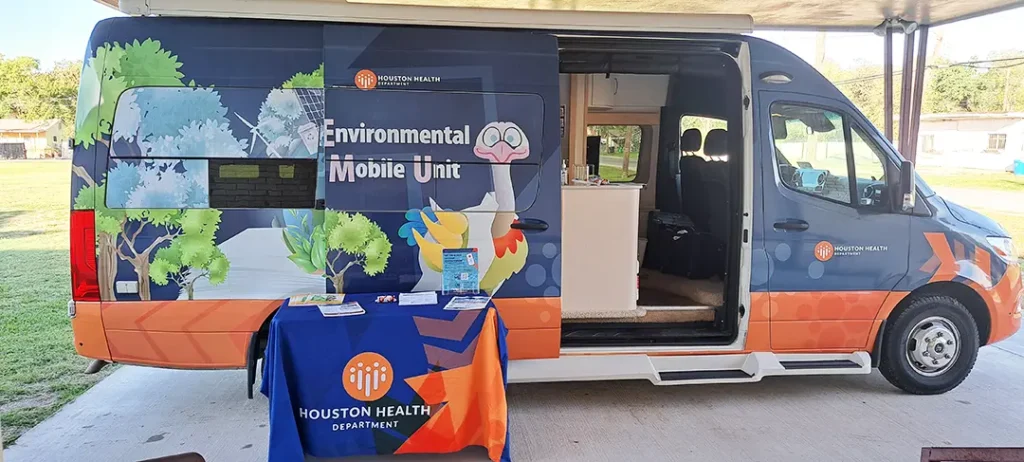
- Environmental Mobile Unit (EMU) operations. Houston also maintains a large van that visits schools, where nurses can provide additional education on asthma self-management to parents and children with asthma.
Required resources
Once established, the AAAAS requires relatively few resources to maintain. However, to launch the program, Houston invested in multiple areas and used pre-existing resources in others.
- Air quality monitoring data. Houston already had pre-existing air quality monitoring data and made use of it for AAAAS.
- Technological capacity and systems integration. Houston used pre-existing health data (specifically, 911 dispatch data from the Houston Fire Department and ESSENCE data) and alert technologies (AlertHouston, based on Everbridge infrastructure) for multi-channel alert dissemination. In this way, Houston did not have to build a new platform for AAAAS.
- Statistical expertise. The Houston Health Department partnered with statisticians at Rice University to identify pollutant thresholds for alerts.
- Community health workers. CHWs and the EMU were essential for field outreach, helping sensitive populations sign up for the alerts.

Barriers to implementation and maintenance
Houston Health Department officials had many resources already in place to design and implement the AAAAS, and the intervention is neither politically provocative nor exceedingly expensive to maintain. However, officials must still surmount at least three key barriers.
- Data access. Obtaining 911 dispatch data early in AAAAS development required strong inter-departmental cooperation. In turn, the Houston Health Department eventually transitioned to using ESSENCE data, which is more readily available, and which it recommends to other cities looking to develop similar interventions.
- Public fatigue. To avoid issuing too many alerts, which could lead the public to become desensitized to them, Houston carefully calibrated its pollutant thresholds and alert systems to ensure that alerts are not issued too often. Retrospective analysis showed that there would have been an AAAAS warning issued on 12% of the days when there wasn’t an AQI alert.
- Financial resources for AAAAS evaluation and adaptation. Houston officials have a large and growing dataset of daily air pollution measures, health outcome data, and AAAAS enrollment and alert issuance data. This data can and should be used to evaluate the efficacy of the AAAAS intervention and, if necessary, to adapt it to maximize its impact and reduce any unintended consequences. However, evaluation and adaptation efforts are limited by financial constraints. Stakeholders involved in air quality policy and intervention design should consider supporting or conducting AAAAS evaluation studies when possible.
Key takeaways
The AAAAS is a novel, low-cost, information-based program to reduce pediatric asthma attacks in Houston. Multiple factors have contributed to the program’s success.
- Communicate. At its core, the AAAAS is a system to facilitate communication between the Houston Health Department, Houstonians with asthma, and their caregivers. The program succeeds because the Health Department augments its alerts with public outreach via community health workers and the Environmental Mobile Unit.
- Collaborate. The development of the AAAAS system required tight coordination between city departments, academic statisticians, public health authorities, and emergency management offices.
- Use existing resources. The AAAAS relies on considerable technological assets, but the program itself did not require Houston to purchase new assets because it relied on tools already available to city officials.
- Tailor risk thresholds. National standards, including the EPA’s AQI, were not sensitive enough for use within Houston. The Health Department’s development of city-specific pollutant thresholds was a key component of the program’s success.
- Avoid “over warning”. Poor air quality is one reason among many for which Houston issues alerts. The success of the AAAAS depends on the public heeding the warnings it provides. If the alert system issues too many warnings, the public may disregard them, and the program will fail.
References
Raun L, Ensor K, Pederson J, Campos L & Persse D. (2019). City-specific air quality warnings for improvised asthma self-management. American Journal of Preventive Medicine, 57(2), 165-171. Available at: https://www.sciencedirect.com/science/article/pii/S074937971930193X
Houston Health Department. (n.d.). Outdoor Air Quality, Asthma Air Aware Day Warnings. Available at: https://www.houstonhealth.org/services/pollution-control/outdoor-air-quality Centers for Disease Control and Prevention. (April 15, 2024). Asthma Cooperative Agreement Partner Profile: Houston. Available at: https://www.cdc.gov/national-asthma-control-program/php/partners/houston-tx.html and https://www.cdc.gov/national-asthma-control-program/media/AsthmaGranteeProfile-HOU-H.pdf