This is a collection of air pollution control technology fact sheets, technical bulletins, and a limited number of software tools. The reports and fact sheets were mostly developed in the 1990's and early 2000's. They cover a wide range of sources and pollutants.
"The National Environmental Public Health Tracking Network (Tracking Network) brings together health data and environmental data from national, state, and city sources and provides supporting information to make the data easier to understand. The Tracking Network has data and information on environments and hazards, health effects, and population health."
CASTNET is a national monitoring network established to assess trends in pollutant concentrations, atmospheric deposition, and ecological effects due to changes in air pollutant emissions.
This guide is designed with government agencies in mind, to help those who must manage the process where public participation is important for decision-making, while incorporating fair treatment, meaningful involvement and social inclusion of all people regardless of race, color, national origin, sexual orientation or income.
From the website: "Share real-time, accurate air quality data with your community through OpenMap to build trust, foster transparency, and drive meaningful environmental action. Empower your stakeholders with intuitive, localized insights to protect their health and keep them informed about their environment. By bridging the gap between your organization and the community, OpenMap transforms data into real-time air quality information and actionable knowledge.
OpenMap visualizes PM2.5 and NO2 Air Quality Index (AQI) data from Clarity's rigorously calibrated Node-S air quality sensors alongside government reference monitors."
Primary compilation of EPA's emissions factor information. It contains emissions factors and process information for more than 200 air pollution source categories.
Envirofacts is the EPA's primary "one-stop shop" for environmental data. It acts as a data warehouse that integrates information from dozens of different EPA regulatory databases into a single, searchable interface
Refined dispersion models listed in the Guideline of Air Quality Models and required to be used for State Implementation Plan (SIP) revisions for existing sources and for New Source Review (NSR) and Prevention of Significant Deterioration (PSD) programs.
The Air Quality Life Index (AQLI) converts air pollution concentrations into their impact on life expectancy. Through the AQLI’s hyper-local data, users anywhere on Earth can zoom into their district and see how much longer they would live if policies were to reduce pollution to meet the World Health Organization’s guideline, a national standard, or a user-defined target. This information can help inform local communities and policymakers about the benefits of air pollution policies in perhaps the most important measure that exists: longer lives.
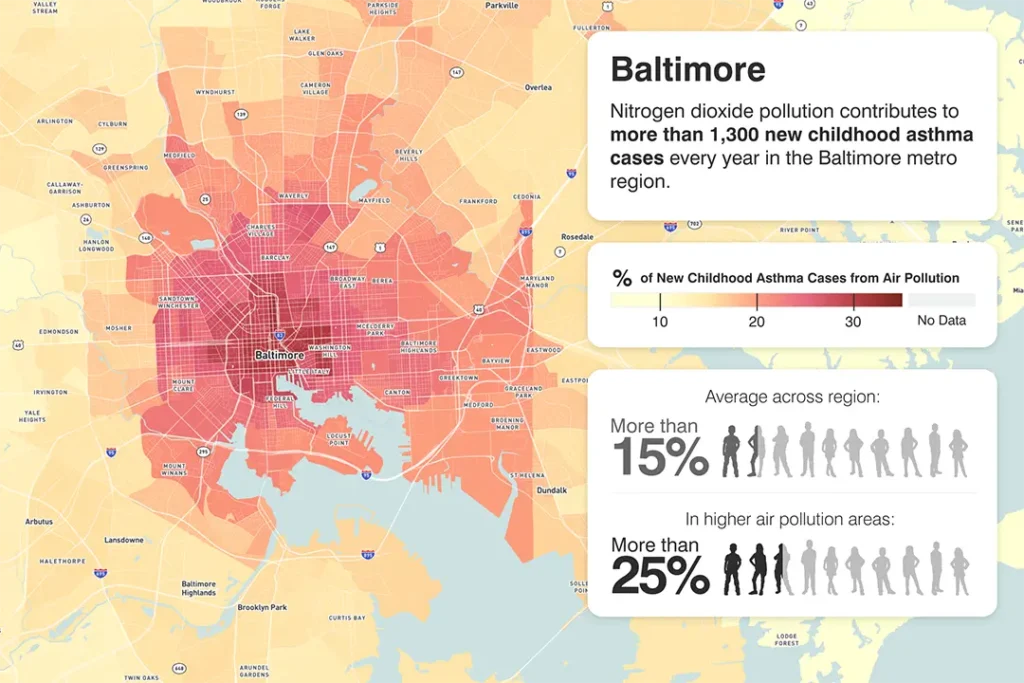
Nitrogen dioxide pollution contributes to more than 1,300 new childhood asthma cases every year in Baltimore metro region.
Subscribe
Sign up to get the latest updates on new city clean air tools and resources.