SPECIATE is the U.S. Environmental Protection Agency’s (EPA) database of organic gas and particulate matter (PM) speciation profiles of air pollution sources, which provide the chemical composition of emissions from sources as a percentage of the total weight of PM or organic gas. Organic gas profiles may represent total organic gases (TOG), volatile organic compounds (VOC) or a variation. PM speciation profiles include data for PM of various size classes, such as PM2.5, which represents the mass of particles less than
or equal to 2.5 microns in diameter. In addition to PM and organic gas profiles, SPECIATE contains other profiles such as for nitrogen oxides, mercury and semi-volatile organic compounds (SVOC).
The resource includes an online browser which allows users to view detailed information about the emissions profile in tabular form or bar and pie charts, as well as downloadable databases.
Mapping tool that provides information on permitted facilities in New Jersey. The tool provides information on the reported emissions for each major and minor source, as well as current information on PM and ozone monitored air quality, and community vulnerability information.
Provides guidance for emissions estimation and downloadable spreadsheet based tools for estimating emissions from several different source categories including asphalt plants, concrete plants, combustion sources, and woodworking facilities.
Report describing a methodology for designing and implementing assessments of interventions to improve air quality. Includes an analysis of case studies, identification of needs, and recommendations for conducting an assessment.
Journal article describing a case study ex ante evaluation of the potential air quality and public health benefits of NYC 80×50 GHG reduction strategy.
This is the text of the Linn County Iowa air quality ordinances. It provides extensive language on control of air pollution sources through rules and permits.
Website for the Portland Clean Energy Community Benefits Fund which invests in community-led projects to reduce carbon emissions, create economic opportunity, and help make Portland more resilient to a changing climate.
Website providing access to tools and resources related to Best Available Control Technologies to reduce emissions of criteria pollutants and air toxics.
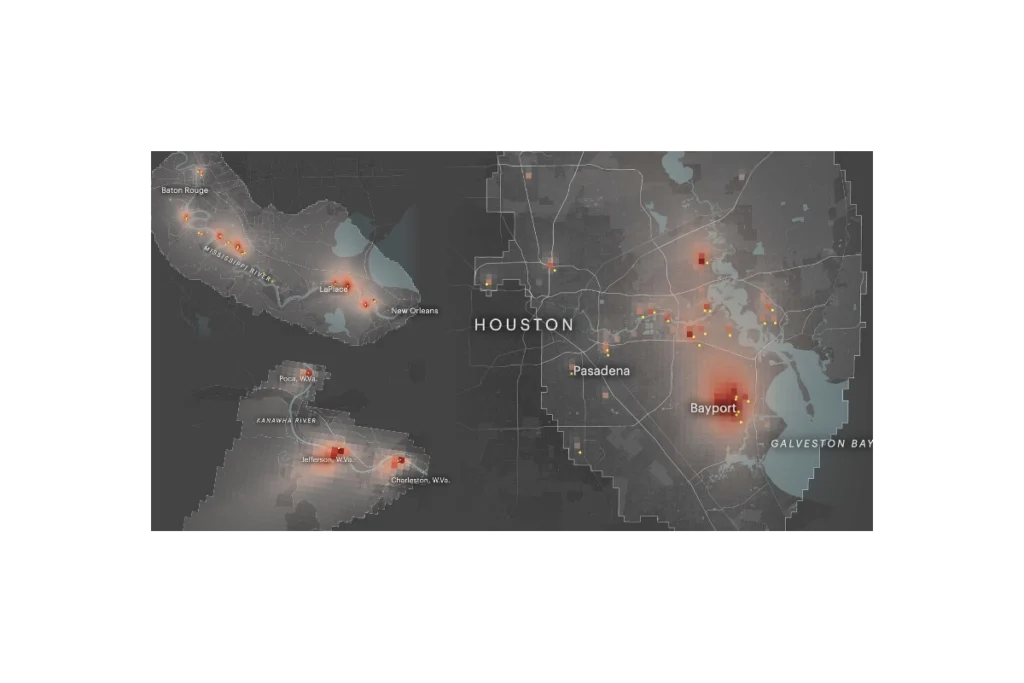
ProPublica’s Toxmap is an interactive map that visualizes estimated cancer risk from industrial air pollution across the United States. Built from EPA emissions and modeling data, it shows how toxic chemicals from thousands of facilities spread into surrounding neighborhoods, highlighting hotspots where cumulative industrial air pollution may raise cancer risk to levels the government considers unacceptable. The site lets users zoom to specific communities, see which facilities are driving risk, and explore patterns of environmental injustice in overburdened areas.
The C40 Communication Toolkit for Air Quality is a product of the best practices shared and lessons learned by these cities and is designed to help cities develop clear messaging, harness the power of visuals, and leverage digital communication channels to inspire collective action to improve air quality.
Subscribe
Sign up to get the latest updates on new city clean air tools and resources.