EPA’s Community Multiscale Air Quality (CMAQ) modeling system is an open-source, regional air quality model used to simulate how pollutants such as ozone, PM2.5, and air toxics form and move in the atmosphere. It combines detailed atmospheric chemistry, emissions, and meteorology to estimate pollutant concentrations and deposition over time and space. The CMAQ website provides the model code, documentation, tutorials, input datasets, and example applications, supporting researchers and agencies in evaluating air quality policies, health and ecosystem impacts, and interactions between air quality and climate.
The toxic flooding vulnerability map is an interactive tool that ranks and visualizes how vulnerable petrochemical facilities and nearby communities in the Galveston Bay region are to toxic flooding. Built from more than 100 indicators across flood risk, chemical transport, facility hazards, ecosystem conditions, baseline health, and social and economic factors, it produces separate vulnerability scores for facilities and for community grid cells. Users—such as planners, engineers, policymakers, and Gulf Coast residents—can explore overall vulnerability, drill down to see which specific indicators drive risk in each location, identify high?priority facilities and neighborhoods, and use downloadable profiles and map layers to help target nature?based solutions that reduce both flooding and chemical exposure.
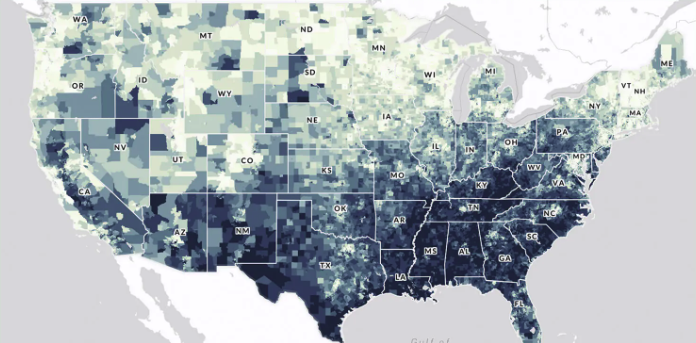
The U.S. Climate Vulnerability Index map is an interactive tool that ranks more than 70,000 U.S. census tracts using 184 indicators to show which communities face the greatest challenges from climate change. It visualizes “overall climate vulnerability” as well as underlying drivers in domains such as health, social and economic conditions, environment, infrastructure, and climate impacts (e.g., extreme events and climate disaster costs). Users can search for any location, compare tracts within a state or EPA region, and drill down to see which specific factors—like housing quality, exposure to pollution, or health burdens—are contributing to vulnerability, helping communities and decision‑makers target climate resilience investments where they are needed most.
Website providing information on state, Tribal, and federal implementation plans. Information included on approved state regulations, source specific requirements, and nonregulatory provisions.
Website providing downloads of two databases: a control measures reference library which provides information on control technologies for a variety of source categories, and a menu of control measures which provides information on existing emission reduction measures including efficiency and cost-effectiveness for large point sources and some nonpoint sources.
Report providing evidence-based guidance to inform local actions to reduce air pollution and its impacts on health. Includes interventions to address mobile sources, buildings, industrial sources, agriculture, and individual behavior.
Provides six case studies of strategies for air pollution management from cities around the world, including New York City, NY; Barranquilla, Columbia; Accra, Ghana; Kampala, Uganda; Jakarta, Indonesia; and Beijing, China. The New York case study focused on enhanced local air quality monitoring to address specific causes of local poor air quality.
Website that provides access to information on local government strategies to reduce emissions of air pollution. Includes information for mobile sources, area, non-road, and stationary sources. Includes model ordinances and policies.
This is a report that provides information on funding and financing approaches that are potentially applicable at state and city levels. It highlights opportunities to leverage public and private financial resources. The report was developed for EU cities, but many of the examples and cases are applicable to U.S. cities.
Subscribe
Sign up to get the latest updates on new city clean air tools and resources.